Claudia de Sousa-baptista
Claudia de Sousa-baptista is a first generation Azorean American fashion designer, tailor, and DJ with an interest in the role artists play as creative catalysts for community building. She is the founder of slow fashion tailor shop Bushwood Tailors Opportunity Shop in New Bedford, MA and is co-founder of NYC tailoring agency Bushwood Tailors and New Bedford slow fashion org FashionRev_NB. As a DJ, “Claudia DeeBee” has recently been exploring past and present sounds of Portugal and its diaspora, first through curated playlists for the Portuguese language cafe, Não Me Digas and now through a project that seeks to reawaken dormant Portuguese LP’s borrowed from her local Portuguese communities by playing them in unexpected public spaces.
Claudio Bueno
Claudio Bueno (São Paulo, Brazil) is an artist, curator, and educator. His practice operates at the intersection of art, technology, ecology, education, and social justice through collaborative projects, installations, research, and collective platforms. He is Assistant Professor of Social Design at the University of California, Santa Cruz, and holds a PhD in Visual Arts from the University of São Paulo (USP). His work has been presented internationally at institutions including the Chicago Architecture Biennial, Whitechapel Gallery, Ars Electronica, the São Paulo Museum of Art (MASP), and the São Paulo Biennial, exploring collective modes of creation and new relationships between communities, territories, and infrastructures.
Evelyn Rydz
Evelyn Rydz works across drawing, site-responsive installations, and community projects to reimagine our relationships with the natural world and with each other. Her practice explores connections between bodies of water, personal histories, consumer cycles, and threats to natural and cultural ecosystems. Rydz has collaborated on community projects with the University of Massachusetts, ICA Watershed, Ethelbert Cooper Gallery of African & African American Art, and MIT List Visual Arts Center. Rydz is a Professor at Massachusetts College of Art and Design.
Filipa da Rocha Nunes
Filipa da Rocha Nunes is a writer and curator from Portugal. She collaborates with national and international artists and institutions, and has presented work at venues such as Sies + Höke (Düsseldorf), Sophiensæle (Berlin), Kampnagel (Hamburg), CAM – Gulbenkian Foundation (Lisbon), Terrada Art (Tokyo), and Camões Angola (Luanda). Between 2019 and 2025, she coordinated Arts and Culture at the Luso-American Development Foundation (FLAD), where she developed programs such as the FLAD Drawing Award and Flechada program. She holds a degree in Painting from the Faculty of Fine Arts of the University of Lisbon and a Master's degree in Cultural Management from the Universitat Internacional de Catalunya. She lives and works in Lisbon.
Filipe Furtado
Filipe Furtado Trio is a group that uses song as a starting point to explore the realms of improvisation, jazz influences, and contemporary sounds. With roots in Coimbra, the trio establishes itself as a space for collective creation, where compositions take shape through the dialogue between piano, saxophone, and drums. In live performances, the group incorporates electronics and vocals. The project is based on the original repertoire of Filipe Furtado — an Azorean musician and composer who has lived in Coimbra since 2010 — and his collaboration with Paulo Silva (drums) and Filipe Fidalgo. In 2025, they released the album “Como Se Matam Primaveras"
FR MoCA
FR MoCA (Fall River Museum of Contemporary Art) is a non-profit contemporary art institution based in Fall River, Massachusetts. Through exhibitions, artistic research, education, and public programs, FR MoCA connects the global contemporary art world with the city's working-class history and communities. Committed to experimentation and collaboration, the institution explores the intersections of art, ecology, technology, and local histories while supporting artists, fostering public dialogue, and expanding access to contemporary artistic practices.

-

In the context of FABRIC 2026, FR MoCA presents a group exhibition curated by Harry Gold Harvey IV featuring works by João Cabral and Nelson Vaz Pires, together with A Maior, an independent curatorial platform based in Viseu, Portugal.
Grace Goodrich
Grace Goodrich is the chef and culinary artist behind Good Rich Food, a project based in Providence, Rhode Island. Her work explores food as a conduit for connection between land, maker, and guest. Inspired by her Portuguese heritage she cooks as an act of remembrance, honoring the matriarchs whose stories live on through her. Her practice celebrates clean soulful abundance and the beauty of shared sensory experience. She believes the table is where community is built and where people come most alive— a place of connection, celebration, and collective joy. Food should make you feel good.
Luzo Auto
LUZO Auto Body Shop is a family-owned auto repair shop in New Bedford that has served the local community for generations.

For FABRIC 2026, the workshop becomes the setting for the festival's closing event, transforming a place of everyday labor into a temporary space for gathering. Through food, performance, and live interventions, LUZO highlights the cultural significance of vernacular, community-rooted spaces and their role in sustaining shared histories, relationships, and cultural continuity across generations.
Melanie Hoff
Melanie Hoff is an artist, organizer, technologist, and educator committed to cultivating spaces of learning and feeling that encourage honesty, poetry, and reconciliation for the ways we are shaped by intersecting systems of classification and power. Melanie engages hacking and performance to reveal how we choose to live and what choices have been made for us. They teach about sex, technology, and social cybernetics Yale University, New York University, and have shown work at the New Museum, the Queens Museum, and elsewhere. Melanie has co-directed two art and technology organizations, School for Poetic Computation and Hex House.
Mia Pinheiro
Mia Pinheiro is an Azorean-American painter and performance artist whose practice spans painting, drawing, installation, and live arts, from New Bedford, MA. Influenced by her apprenticeship with Mexican painter José "Pepe" Barbosa and the collective El Quinto Piso in Mexico City, her work explores the expressive potential of the figure, still life, and material processes. Working from her studio at Kilburn Mill in New Bedford, Pinheiro creates works that investigate identity, embodiment, and ritual through painting, performance, and handcrafted pigments.
Project Calafonas
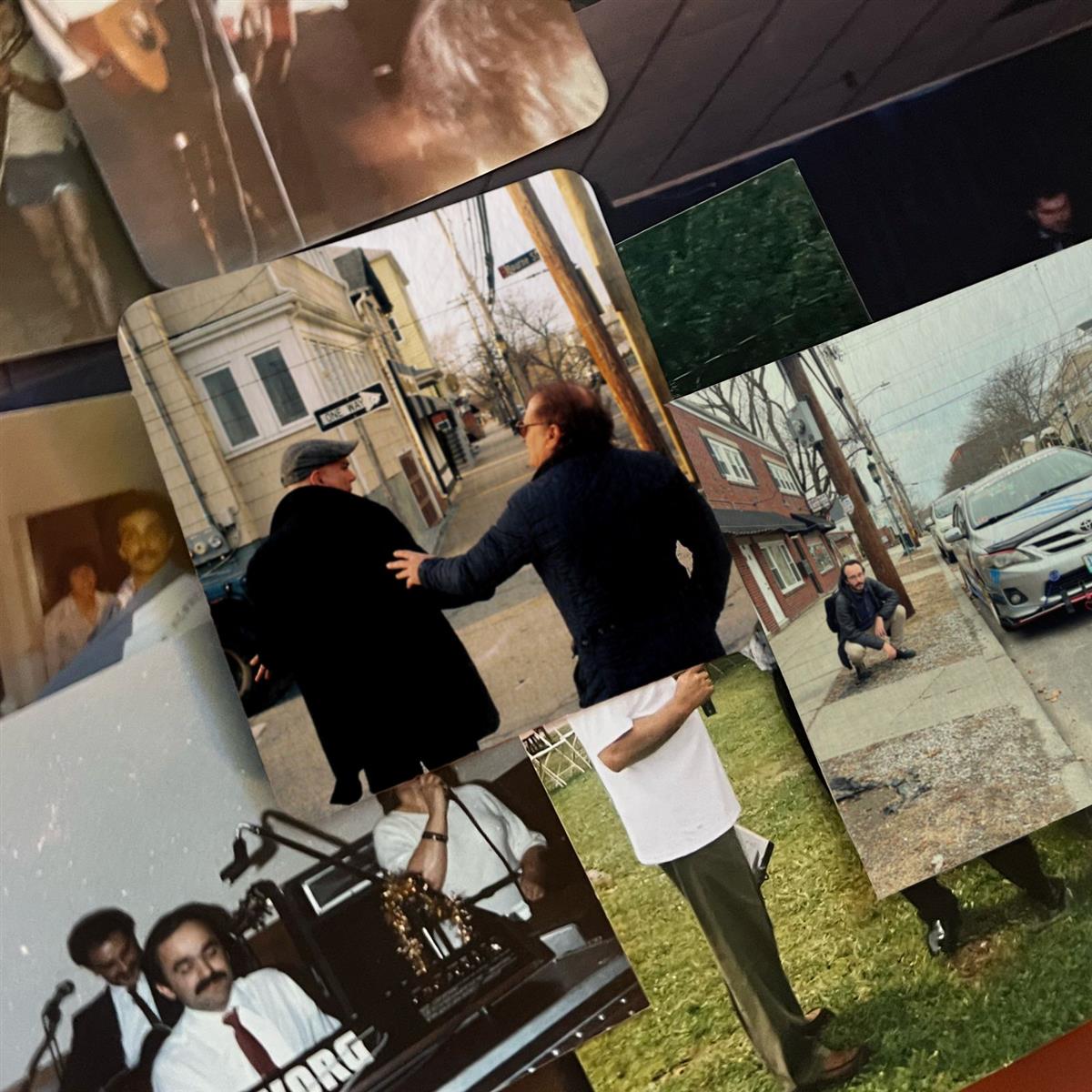
Project Calafonas is a research and artistic project by Henrique Furtado Ferreira and Diogo Lima focused on the musical history of Portuguese and Azorean communities in North America during the 1970s and 1980s. Developed through archival research, interviews, listening sessions, and encounters with musicians and community members, the project recovers a lesser-known cultural history shaped by pop, rock, disco, and other forms of popular music.

Taking its name from Calafonas: Music from the Azorean and Portuguese Diaspora (1970s–1980s), a compilation released by Henrique Furtado Ferreira, the project challenges narrow representations of Portuguese diasporic culture as exclusively connected to folklore and religious tradition. Through music, moving image, and storytelling, Project Calafonas explores migration, cultural adaptation, memory, and the ways identities are transformed across generations.

For FABRIC, the project has unfolded through research in New England, public listening sessions, a lecture-performance, a dinner-performance, and the development of a new short film centred on the musicians and stories encountered throughout the process.

-

Henrique Furtado Ferreira (b. 1981, Ponta Delgada, Azores), also known as DJ Milhafre, is a DJ, record collector, editor, and researcher. He released Calafonas: Music from the Azorean and Portuguese Diaspora (1970s–1980s), a compilation bringing together musical recordings rediscovered from the Luso-American past. Across his work, music becomes a way of tracing connections between culture, migration, memory, and identity.

Diogo Lima (b. 1993, São Miguel, Azores) is a Portuguese director and editor working across fiction, documentary, and advertising. Often grounded in humour, his projects explore the particularities and contradictions of Azorean identity. His work includes the documentary AZ-RAP: Sons of the Wind, the web series Sou Menino Para Ir for FOX Comedy and RTP1, and the short fiction film The Last Days of Emanuel Raposo.
7th edition - Oct 8-11th / 7th edition - Oct 8-11th / 7th edition - Oct 8-11th / 7th edition - Oct 8-11th / 7th edition - Oct 8-11th / 7th edition - Oct 8-11th / 7th edition - Oct 8-11th / 7th edition - Oct 8-11th / 7th edition - Oct 8-11th / 7th edition - Oct 8-11th / 7th edition - Oct 8-11th / 7th edition - Oct 8-11th / 7th edition - Oct 8-11th / 7th edition - Oct 8-11th / 7th edition - Oct 8-11th /